SERVICES
At In-Depth Locations, we provide professional subsurface locating, scanning, and assessment services to support safer construction, informed planning, and reduced underground risk.
Our services combine advanced technology with practical, on-site experience across civil, commercial, and infrastructure projects throughout South Australia. This includes Stream DP (Deep Penetration GPR Scanning), our most frequently requested service utilised on complex and high-risk sites where increased depth capability and enhanced interpretive confidence are required.
Every scan is approached with accuracy, clarity, and accountability, because reliable information below the surface is critical to every project’s success.
Learn more about our services and how each supports safer, more informed construction outcomes below.
Our Services
-
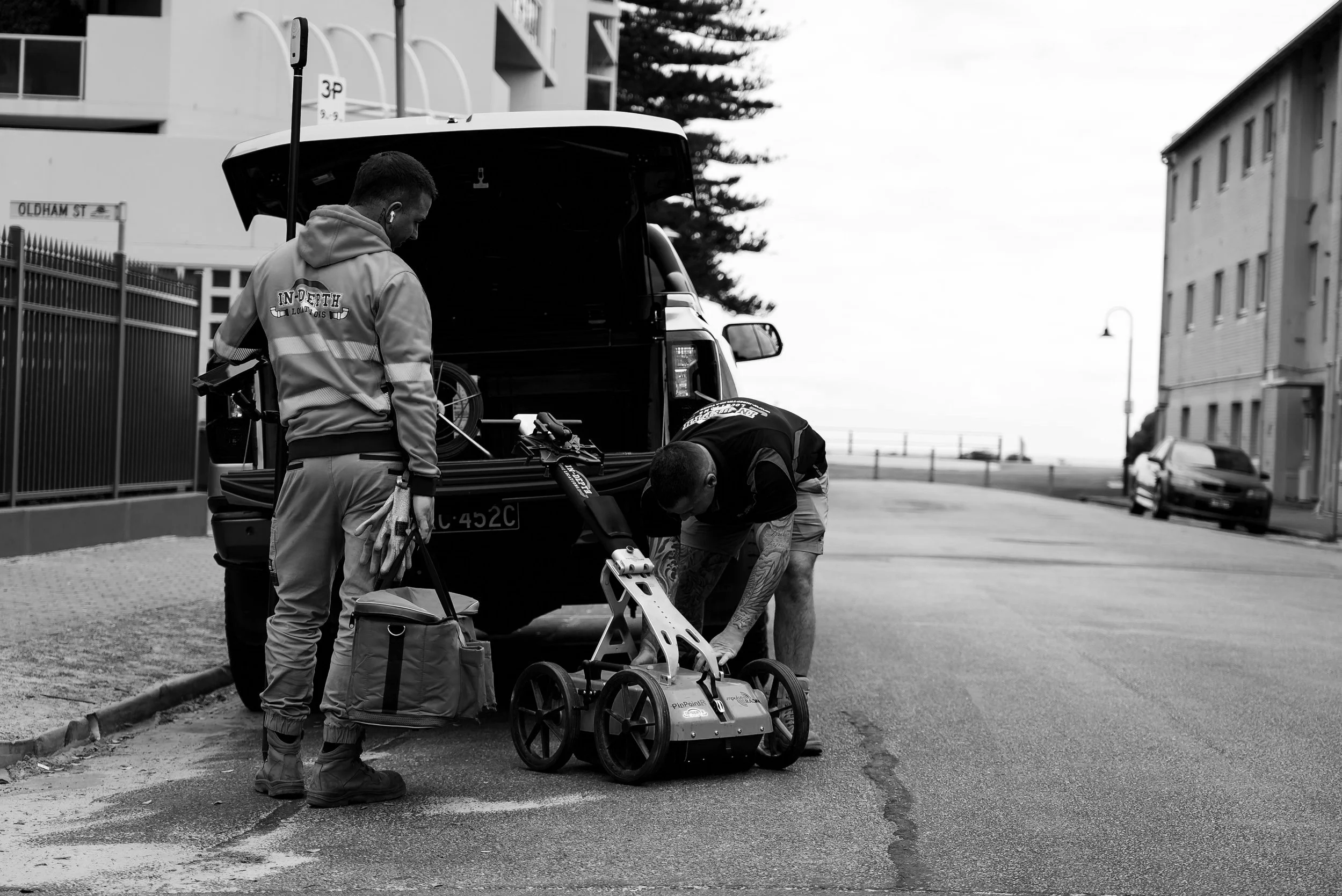
Stream DP is one of the most advanced 3D underground scanning systems available, allowing us to capture high resolution subsurface data quickly and accurately across complex sites. At In-Depth Locations, we use this technology to help civil contractors, builders, councils, utilities, and engineers clearly understand what lies beneath the surface before excavation or construction begins. By identifying services, voids, and potential clashes early, we reduce risk, prevent costly delays, and support better design and construction decisions. Our structured site methods and clear, easy to read reporting ensure the data is practical, usable, and trusted by project teams. While others may operate similar equipment, we’ve set the benchmark in South Australia for how Stream DP is applied delivering confidence on site, not just scans.
-
Electromagnetic Induction (EMI) locating is a non-destructive method used to identify metallic underground services, including electrical cables, water and gas mains, and telecommunications infrastructure.
Using advanced electromagnetic equipment, services are traced and marked to provide accurate horizontal positioning and, where possible, depth information. EMI locating is commonly used prior to excavation, trenching, or drilling to reduce the risk of service strikes and project delays.
This method is best suited to live or traceable metallic utilities and is often used in conjunction with other locating techniques to improve overall accuracy.
-
Ground Penetrating Radar (GPR) is a non-destructive scanning method that uses high-frequency radar pulses to identify subsurface features and changes in material composition.
GPR is commonly used to locate non-metallic services, conduits, reinforcement, voids, and structural elements that cannot be detected using electromagnetic methods. It is particularly effective in concrete scanning and subsurface investigations where detailed structural information is required.
Results are interpreted by experienced operators and are often combined with other locating methods to improve accuracy and confidence on site.
-
Our GPS mapping service records the position of located services and site features using accurate geospatial data capture methods.
This information is used to create clear, practical maps that support project planning, coordination, and documentation. GPS mapping assists with asset visibility, as-built records, and ongoing site management, helping clients maintain reliable reference information beyond the construction phase.
Mapping outputs are provided to suit project and documentation requirements.
-
Potholing is a controlled, non-destructive excavation method used to physically expose underground services to confirm their location, alignment, and depth.
This process is commonly undertaken to verify critical utilities prior to excavation or construction works, providing visual confirmation where locating alone is not sufficient. Potholing supports risk reduction and improved site safety by removing uncertainty around service positioning.
-
Rodding and sonde techniques are used to trace the path and alignment of non-metallic pipes and conduits that cannot be detected using electromagnetic locating alone.
A flexible rod is inserted into the service, with a sonde transmitter used to track its position from the surface. This method allows for confirmation of service routes, changes in direction, and connection points, and is commonly applied in drainage, sewer, and conduit investigations.
-
CCTV inspection involves the use of specialist camera equipment to visually assess the internal condition of underground pipes, drains, and conduits.
This service is used to identify blockages, defects, structural damage, and general condition issues with minimal disruption to the surrounding area. CCTV inspections support maintenance planning, fault identification, and verification of asset condition.
-
Schmidt hammer rebound testing is a non-destructive method used to assess the surface hardness of concrete and provide indicative information on relative concrete strength.
This testing is commonly used for comparative assessments, preliminary evaluations, and quality checks across concrete elements. Results can assist in identifying variations in concrete condition and determining whether further investigation or testing may be required.
Schmidt hammer testing does not replace laboratory testing but provides a practical on-site assessment tool when intrusive testing is not suitable.
Not sure which service is right for your project?
Our team can help identify the most suitable solution based on your site and requirements.